First, Forget What the Media Told You
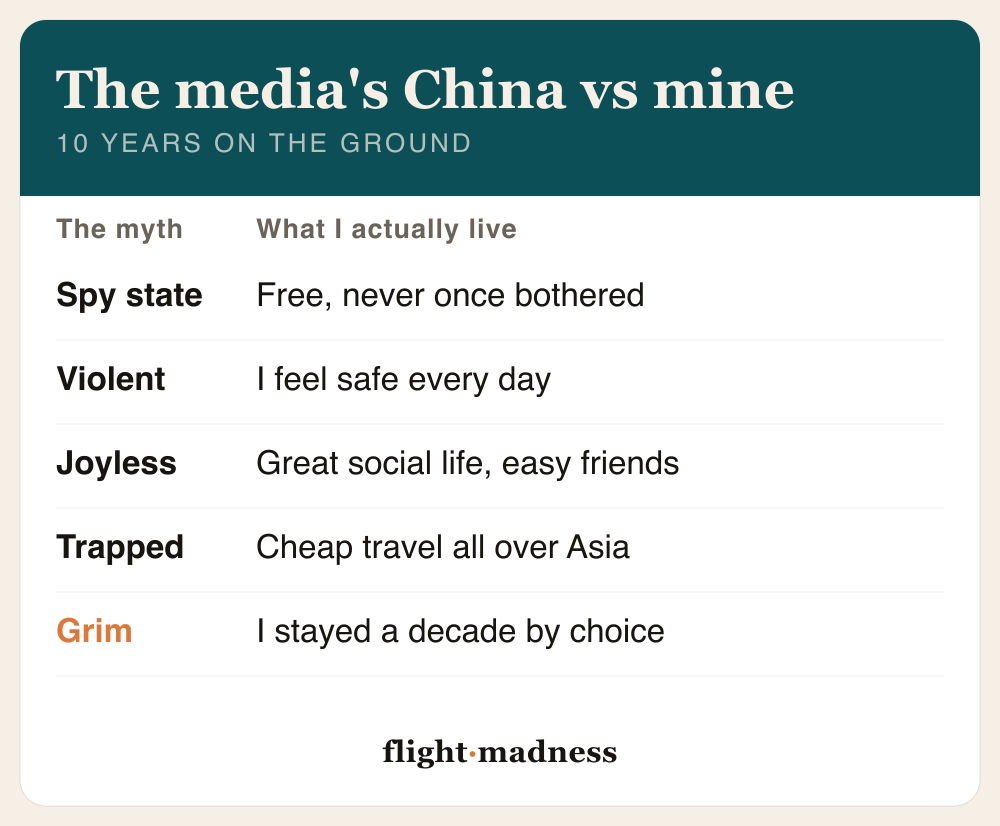
China has a brutal reputation in Western media. The vast majority of what you see is negative, and a lot of guys are genuinely afraid to come, they think they'll land and get captured by the Chinese government for being American. People half expect me to be some communist spy who hates American freedom. It's nonsense.
I'm a Black American who's lived here happily for a decade. The picture in your head, the super-strict, joyless, dangerous communist place, does not match the life I actually live. There are a lot of falsehoods out there. Give China a fair shot and ignore the noise, and what you find is very different from the headline.
How I Even Ended Up Here
Quick backstory, because it matters. I'm an engineer by trade. I got a full-ride scholarship to the University of Arkansas for industrial engineering, and my classmates were all fired up to go work in some factory making six figures. That life just wasn't for me. I did not want to get caught up in that Arkansas routine: settle down young, work a nine-to-five, buy a car and a house, and take on a mountain of debt to pay for all of it.
In my last year of university I stumbled onto English teaching, and it clicked instantly. You go to a foreign country, teach in one of their schools, get paid well, and live better than you would back home. Better still, you can do it across a huge range of other countries, so as an English teacher you get to pick where you actually want to live. That was the whole unlock for me.
There was a personal piece too. Landing somewhere new felt like a genuine fresh start. Nobody there knew me, so I could drop all the old baggage from home. Growing up I never really fit in. My mom was in the military for over 20 years, I was born in South Carolina and spent a few years as a kid on a base in Germany, and back in the South I always felt like an outcast. Getting on that plane wasn't running away. It was finally lining my life up with how my head actually worked.
The People Are More Open Than Back Home
Here's something nobody warns you about, in a good way. It's easy to make real friends here.
I grew up in the South, Georgia and Arkansas, and I never clicked with the people around me. I had a bit of an international childhood (my mom was military, so I spent a few years in Germany), and back home I just couldn't link up. Out here it's the opposite. The people who move to China are already open-minded, already wired to travel, already living outside their comfort zone. So you find your people fast.
And that changes everything. Back in America, a lot of guys can't even get their friends to commit to a trip, they flake at the last second. Out here, my crew already lives overseas, so we organize real international trips together. The friendships I've built in China are why I'm never doing this alone.
The social life backs that up. I know a lot of you guys go out to the club back home and it's dead, nobody wants to talk, the night's a wash. That was my experience too in a small college town in Arkansas, a real mixed bag. Out here it's the opposite. Just about any night of the week I can go out, meet people, and have a genuinely good time. People warn you China is some joyless, super-strict place. The nightlife and the social scene tell a completely different story.
A Typical Week in My Daily Life
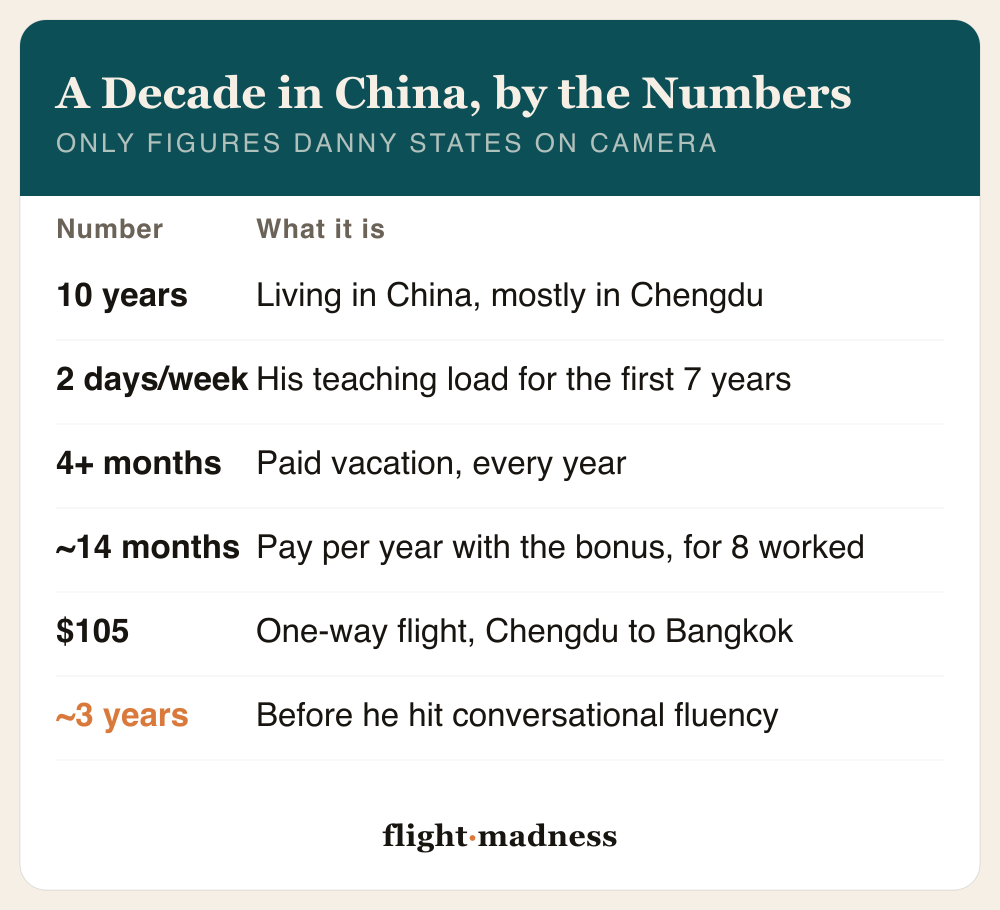
Here's what the actual week looks like, because this part sounds fake until you live it. For the first seven years at my university job, I taught two days a week. Monday and Tuesday, and that was it. Five days off, every single week, plus more than four months of paid vacation a year.
The pay math is just as good. With the year-end bonus, worth about an extra month's salary, I'm basically paid for 14 months while working eight. And the number itself is strong for the city. There are Chinese people here working a full 40-hour week who don't take home half of what I make.
Even the workdays are light. Between classes I get 20 or 30 minutes to myself, and I've read a whole stack of books at this job. It's a slow-paced daily life in a big Chinese city, and I won't pretend otherwise: I'm relaxed, I'm not stressed about work, and I don't have to grind. That free time is the entire point. It is real hours for travel, hobbies, and building things on the side, like this channel.
China Is the Best Travel Base in Asia
This one surprised me. Living in China is like parking yourself at the center of Asia.
Cheap flights everywhere. I once caught a one-way from Chengdu to Bangkok for about $105. You can be in a completely different country in under four hours. Domestic travel is just as good, fast and cheap across a massive country.
And China is incredibly diverse. Ten years in, I still haven't seen it all. The food, the culture, and the whole environment shift completely from one Chinese city to the next. My home base, Chengdu, sits in Sichuan Province, which is famous for the pandas and for some of the spiciest food in the country. You do not need to be in the giant first-tier cities like Beijing or Shanghai to build a great life. Plenty of the best major cities for foreigners are ones people back home have never even heard of.
Bored of one place? I could jump to somewhere like Hainan, the island province, which feels a lot like Thailand. You don't get stuck, you get options. Thinking about the move itself? I covered it in moving to China.
Honestly, I think a lot of people who grow up in Asia take this completely for granted. As a foreigner, you actually feel how rare it is. A completely different country and culture sits a short flight from home, and I can take a trip basically every week if I want. It's just not a big deal here.
The part I'm chewing on now is Hainan, the island province down south. The lifestyle there is comparable to Thailand, so I could live somewhere that feels like the beach and still be in China, still speaking Chinese day to day. That's the thing people miss about this country: it's so vast that you can completely change your life without ever leaving it.
Want the Free Teaching Guide?
Grab my free Quickstart Teaching Guide. It lays out the countries, the jobs, and the money, so you can see exactly how teaching gets you a life like this overseas.
Free guide. Real information, not hype. Unsubscribe anytime.
The Money and the Lifestyle
Here's the part that makes the rest possible. I've taught English here for 10 years, and there are so many teaching jobs for foreigners that going broke has never been a real fear. The living costs are low and a teaching salary sits well above them, so every month I'm running a profit. I broke the actual numbers down in cost of living in China.
That surplus buys the thing money is actually for: time. My friends joke that I don't really work, and honestly, compared to most people, I don't. You don't take a university job in China for a huge paycheck, you take it for the lifestyle it hands you. This is plain geoarbitrage, a strong salary against a low cost of living.
Safer Than the Headlines, and I Got Healthier
This is the one I didn't expect to matter so much, and it's the fear that keeps most guys home. Real talk: in ten years on the ground, I never felt in danger. That whole scary picture the media paints never once matched my actual day-to-day. I feel safe here, plain and simple.
I'm not worried about random violence, about someone running up on me, about the stuff that quietly stresses a lot of guys back home. I don't have to think about going outside and catching some extra bullet holes in my wardrobe. I know a lot of you wish you could say the same, and out here it's just real. I can be free.
My anxiety is low. I'm in the best shape of my life, exercising regularly, just generally healthier. I genuinely believe living here has stretched my lifespan, probably by at least 10 years, purely from how much my stress levels dropped. Safety and peace of mind sound boring until you've lived without them. Worried about the safety question specifically? Watch the video above, I go straight at it.
The First Year Was One Big Hassle
I won't sugarcoat the start. China was like landing on a different planet, and the culture shock was real. It's a much harder transition than somewhere like South Korea, because at first basically everything is a hassle. Setting up a phone, opening a Chinese bank account, moving money back to my American one, all the small stuff you never think about took real effort.
And here's the strange part: even with all that, my first year was one of the most peaceful of my life. I was in a small town, I had money and free time, and every day I could work out, meditate, and read. That small-town landing when you first go overseas can genuinely reset your head and put you in a new frame of mind.
It got better fast, too. After that first year I moved to a bigger school in a bigger Chinese city, Chengdu. By my third year I had a job at the top university in Sichuan Province. Every year the jobs got better. That's the pattern nobody tells you about: you don't have to arrive with it all figured out, you just have to arrive.
The Language Wall, and Breaking Through at Year Three
When I first came to China I couldn't speak Mandarin at all, and it humbled me quick. I still remember sitting at dinner with a coworker and another Chinese guy, wanting the tissues, and having no way to ask for them. I'm basically grunting like a caveman across the table. That's the daily reality at the start, and it wears on you when you can't yet speak the language.
Around the three-year mark it finally broke open. I hit the point where I could hold a full conversation without reaching for a translator, and everything started to flow. I can't overstate what that did for me. It took a huge weight off my mind and made my quality of life here so much better. It didn't come free, though. I put in hundreds of hours, studying on my phone every day and practicing with locals, to get there.
My Honest Regrets After a Decade
Ten years in, I've got a few real regrets, and I'd rather you learn from them than think the whole thing was flawless.
The biggest one: I didn't travel nearly as much as I should have. There was about a three-year stretch where China was basically closed off, and even outside of that I let too much time slip by without getting out to see the region. The funny thing is, living abroad doesn't automatically fix that. If you don't actually travel, you can still fall into a scarcity mindset with the whole world on your doorstep.
Another one, for the guys with big plans: be very careful about trying to run a business in China. I've watched a lot of foreigners come in with huge dreams of building a Chinese company, and for most of them it does not go well. Doing business over here takes an enormous amount of energy and turns into a giant headache, and some people have had their lives genuinely wrecked chasing it. Teaching is a very different, much safer game, which is a big part of why I stuck with it.
And I probably over-invested in the language. I spent six or seven years seriously studying Chinese, including a full year on old idioms that are fascinating but almost useless in daily conversation. I don't fully regret it, I enjoyed it, but if I did it again I'd point some of those hours somewhere with a bigger payoff.
Why I'm Going Remote Now
After all these years, I'm moving on from the university job, and the reason is simple. For my first seven years I taught two days a week, but they changed the deal and now I have to come in three days a week. That might sound like nothing, but I did not move to China to wake up early and commute like it's a normal nine-to-five. That's the exact life I left America to escape.
So I'm going all in on online English teaching. I make more per hour, and all I have to do is open my laptop. No commute, no early alarm, no fixed place I have to be. That university job was the best of my life for a long time, right up until online teaching quietly became better. If you want the mechanics of that shift, I get into it in how to make money while traveling.
The Honest Catch
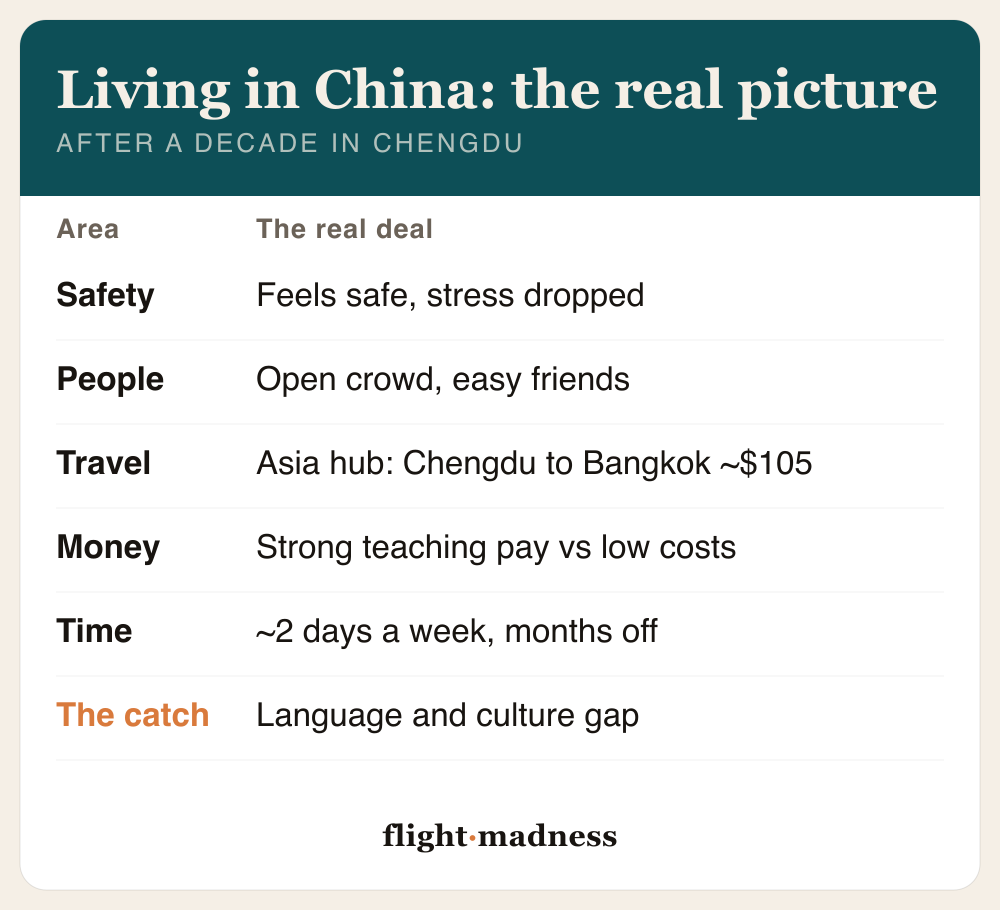
So here's the honest bottom line. China asks more of you up front than a place that rolls out the carpet for first-timers. Between the culture shock, the Chinese customs you have to learn to read, and the language you have to earn, the first stretch is real work. None of it is a dealbreaker, but this country hands the biggest upside to the guys who are actually ready for an adventure.
And here's the freeing part: you're never locked in. I could jump to a totally different part of China whenever I wanted, and Hainan, the island province, honestly has a vibe comparable to Thailand. China can be your home base or your launch pad into the rest of Asia. If you're weighing it against somewhere like Thailand, I broke those numbers down in cost of living in Thailand.
Want to See It For Yourself?
If China's been living in your head, let's make it real instead of a daydream. Book a free 15-minute Get Overseas Strategy Call with me and we'll figure out whether China's your move or whether another country fits you better, and map the steps to get you there. I gave China a decade and it gave me a life I couldn't have built in America. Most guys never even find out what they're missing.
Book My Free 15-Minute Strategy Call →Free. No pressure. Just a clear next step.
Frequently Asked Questions
Is it safe to live in China?
In my decade living there, far safer than the fear-mongering suggests. I never worried about random violence, my stress and anxiety dropped, and I got into the best shape of my life. Do not let headlines from people who have never been there make the call for you.
Can Americans live in China?
Yes. For most guys the route is English teaching, which is a massive field over there and not hard to find a job in. It gives you the income and the reason to be there, and you build the rest of your life from that.
Is China a good place to live for foreigners?
For me, over ten years, yes. You meet an open-minded expat crowd that is easy to make friends with, a low cost of living against a solid teaching salary, cheap travel all over Asia, and a low-stress, safe day to day. The trade-off is the language barrier and culture gap, which fade as you adapt.
What is the hardest part of living in China?
For me it was the language barrier and the cultural differences when I first arrived. It was rough at the start, and it took me a while to adapt. China just asks a bit more of you up front than a soft-landing country, and the upside is bigger if you are ready for it.
What is daily life in China really like?
For me, slow-paced and low-stress in a big city. I taught two days a week for years, had months of paid vacation, and spent the free time on travel and hobbies. The food is incredible, my stress was far lower than it ever was in America, and my health got a lot better as a result.
How bad is the culture shock in China?
Real at the start. China is a harder landing than somewhere like South Korea, and the first months are a hassle while you sort out a phone, a bank account, and the language. It fades fast as you adapt, and for me that rough first year was still one of the most peaceful of my life.