The Real Story Isn't the Price. It's the Gap.
Here's the thing most cost-of-living articles miss. The number that matters isn't your rent. It's the gap between what you earn and what it costs you to live.
In China, a teaching salary is strong compared to what life actually costs there. You earn at one level and you spend at a much lower one, and that gap is where everything good happens. I watched guys save real money while still living well. That's the whole game, and I broke the mechanism down in geoarbitrage.
So yes, China is affordable. But the magic isn't "cheap." It's "cheap relative to what you make there." Big difference.
Where the Money Actually Goes
Let me walk the buckets so you can see where the money goes, even without me quoting you exact figures. Your city changes everything: the major cities like Beijing and Shanghai cost a lot more, while a place like Chengdu or other Chinese cities stretch your money way further. Most cost-of-living-index sites lump it all together, but your real living expenses come down to which city you pick and how local you go.
Rent. Your biggest lever, by far. An apartment in the centre of a major city costs real money; the same place outside the centre, or in a smaller city, is a fraction of a US city. Rent is the line that swings your whole budget, and here's the quiet win: a lot of teaching jobs help with housing or hand you a housing stipend, which drops this bucket even further.
Food. Eating local is genuinely cheap and genuinely good. Chinese food at neighborhood spots costs pocket change, and a normal meal out barely registers. Go full Western every meal and it climbs, but day to day, food is not what breaks your budget.
Getting around. No car needed, which quietly deletes one of the biggest bills Americans carry. The subway or a cheap taxi gets you across town for next to nothing, and high-speed trains between cities make American travel look like a joke.
The digital convenience. One thing that surprises Americans: China runs almost entirely cashless. You pay for everything with your phone, from the corner shop to a street vendor. It's wildly convenient, and it makes keeping an eye on your spending easy if you actually look.
The Numbers I Can Actually Give You
I'm not going to invent a grocery bill or a rent figure for you. But I'll give you the numbers I know cold, the ones from my own life, because those are the ones that actually decide whether the move works.
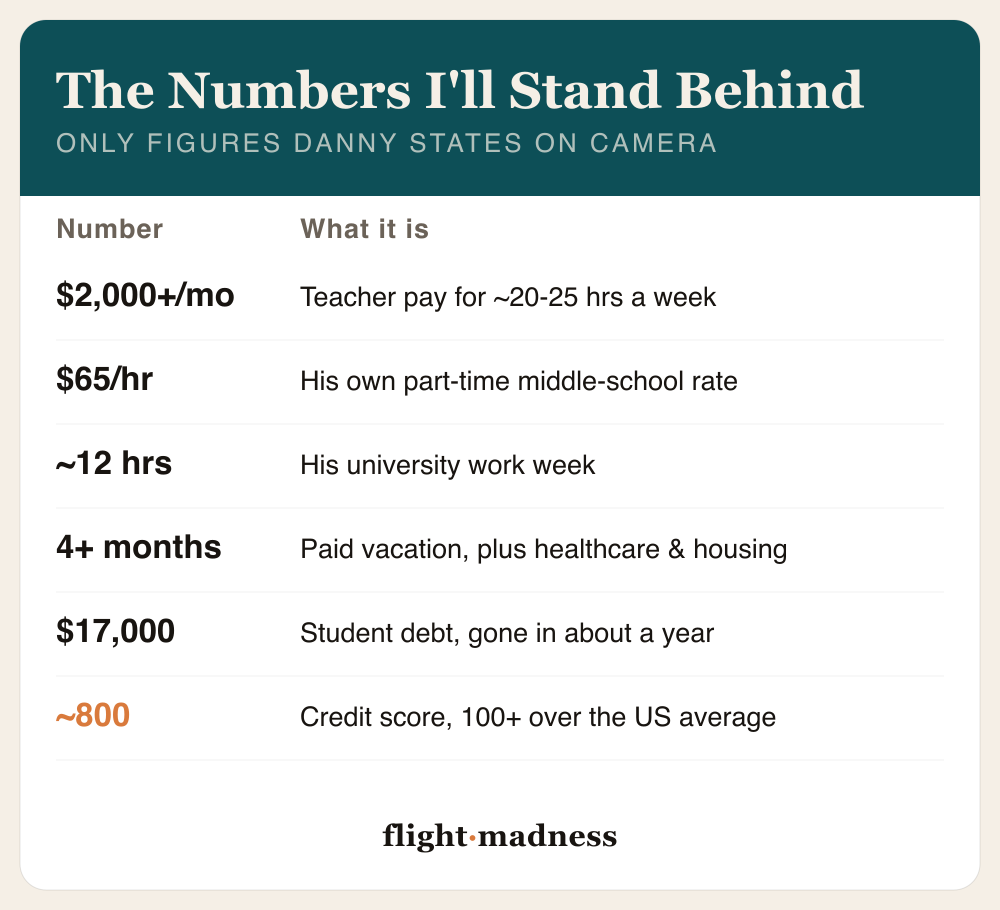
Start with the income, because that's the half nobody shows you. A teacher in China working around 20 to 25 hours a week makes at least $2,000 a month on the low end. There are teachers pulling $5,000 to $10,000 a month for similar hours.
I had a part-time gig at a middle school that paid me over $65 an hour just to show up and teach. My university job ran about 12 hours a week, and online teaching adds another 4 to 12 on top, depending on how much I feel like working. Add it all up and I'm working under 25 hours a week.
That university job didn't just hand me a salary, either. It came with over four months of paid vacation, healthcare, a housing stipend, and a travel stipend, and it sorted my visa. The housing stipend alone was enough to live very comfortably. When your rent is subsidized and your pay is strong against local prices, the math stops looking like survival.
And it starts looking like the word I actually use: profit. Most of the money I make out here is pure profit, because I've got no debt and a low cost of living sitting underneath it. That's the number that matters, not what some website says a cappuccino costs.
Which City Changes Everything
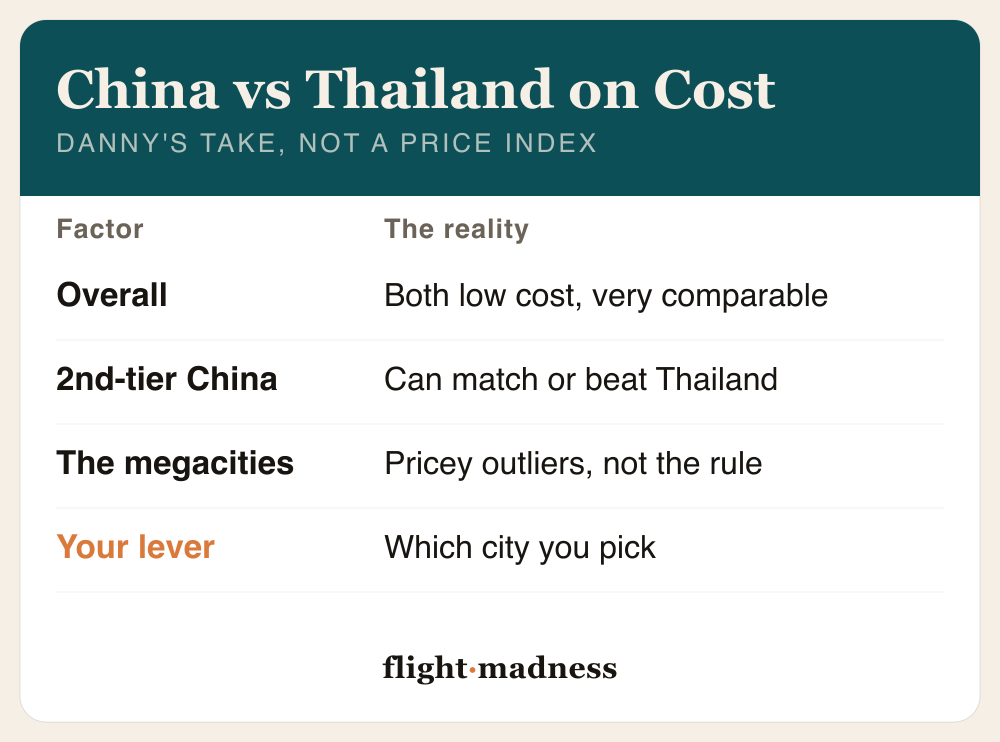
The single biggest thing that swings your cost of living in China isn't your lifestyle, it's which city you pick. A cost-of-living index lumps the whole country into one number, and that hides the truth: the megacities like Beijing and Shanghai cost a lot more than a second-tier city like Chengdu, where I lived. Same country, wildly different price tag.
Here's the part that surprised me most: China is so big and so varied that plenty of its cities cost about the same as Thailand, and some come in even cheaper. So if saving is the goal, skip the megacities. Live in a second-tier Chinese city and the same teaching salary suddenly has a lot more room underneath it. The cities are ridiculously convenient too: cheap to get around, bikes and taxis everywhere, a clean subway, and no real need to own a car.
Those index sites are fine for a rough ballpark, but they miss the part that actually matters for you: the teaching salary on the other side of the equation, and the fact that a lot of jobs cover or subsidize your rent. The number on the index page isn't your number.
China vs Thailand: How the Cost Compares
People assume Thailand is the budget king and China is expensive. That's not what I found. When I compare the two, they're actually very comparable on cost. China is so big, with so many different cities, that plenty of them land at the same price as Thailand, and some come in generally cheaper. The major cities like Beijing and Shanghai are the expensive outliers, not the rule.
So if you're choosing between the two purely on money, it's a lot closer than people think. I put the full picture in cost of living in Thailand, and the full side-by-side in China vs Thailand. The short version is this: both countries have a low cost of living, and in China your city choice is what decides whether you land above or below the Thailand line.
What Living in China Actually Costs Each Month
Same city, three different price tags, depending on how you live. Outside the megacities it breaks down roughly like this:
Bare-bones: a small or shared place, all local Chinese food, public transport only. New teachers who live this way bank most of their salary. It's how a lot of guys clear their debt fast.
Comfortable teacher life: your own one-bedroom apartment, eating out most days, a gym membership, weekend trips on the high-speed train. This is the sweet spot most guys land in, and a teaching salary covers it with plenty left over.
Western-heavy: imported groceries, Western restaurants every day, a nicer central apartment in a big city. The price climbs, but here's the thing, it's still under what that same lifestyle costs in a US city. That's the gap Americans feel immediately: even living large in China, you're spending less than you did back home while still earning enough to save.
How Much You Need Coming In Before You Move
People ask me the wrong version of this question. It isn't "how cheap is China," it's "how much do I need coming in before I go." My honest rule: have at least $1,000 a month in income lined up before you move. That's the floor. Around $1,500 a month or more is a more comfortable starting point, and it buys you breathing room while you get set up.
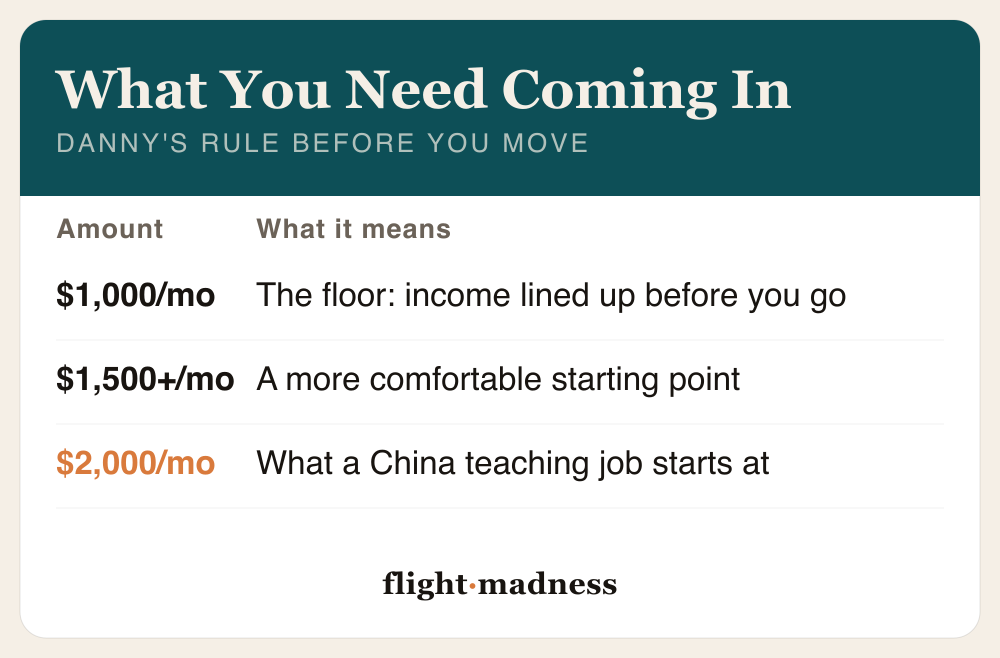
The good news is a teaching salary clears that bar without breaking a sweat. A teaching job in China starts around $2,000 a month, so the "can I afford it" math is basically solved the day you sign a job offer. The threshold isn't there to scare you off. It's there so you move with a runway instead of a prayer. If you want to see a whole month built on that kind of budget, I mapped it out in how to live abroad on $1,000 a month.
Want the Free Teaching Guide?
Grab my free Quickstart Teaching Guide. It lays out the countries, the jobs, and the money, so you can see exactly how teaching covers a low cost of living overseas.
Free guide. Real information, not hype. Unsubscribe anytime.
How It Let Me Kill My Debt
Here's the part that made it real for me. When I left America I had over $17,000 in student loan debt, and man, I HATED owing that money. At my lowest the stress of it really wore on me.
Teaching in China wiped it out after about a year of grinding, and it was simple, because my cost of living was so low that my paychecks actually had somewhere to go besides survival. When your rent is cheap and your salary is solid, money finally does something other than disappear. I'm debt-free now, and my credit score sits around 800, which is more than 100 points above the average American. That's not a hack. That's just what happens when the gap is in your favor.
So How Much Can You Actually Save?
This is the number those cost-of-living index pages can never show you. Because the living costs are low and the teaching pay is solid, most of what I earn just turns into savings. That's not a figure off a website. It's my real experience: no debt, low costs, and a salary that covers my whole life several times over.
How much you keep comes down to how you live. Stay lean and you bank most of your salary. Spend more and you still come out ahead. Either way, the cost of living in China works in your favor in a way it almost never does on a normal American paycheck.
The Honest Catch
Real talk: China is a fantastic place to earn and save, but it's not always the easiest first step abroad. Compared to Thailand or Vietnam, which roll out the carpet for first-timers, China asks more of you up front, the visa, the paperwork, the culture and language gap.
So if you want the biggest earning-and-saving upside and you're up for a real adventure, China is hard to beat. If you want the gentlest on-ramp, you might start somewhere easier and compare the numbers. I laid out the Thailand version in cost of living in Thailand, and what teaching in China is actually like in teach English in China.
The Part That Actually Matters
A low cost of living means nothing if you've got nothing coming in. The number only works when you've got a way to cover it.
That's why I push English teaching so hard. It's the closest thing to a cheat code Americans have: it gets you the work visa, the income, and a soft landing all at once. And it isn't the only stream. Teaching is my engine, but online teaching pays even better per hour, my consultations bring in another chunk, and even YouTube adds a bit on top. Stack a few of those against a low cost of living and, like I said, most of it comes out as profit.
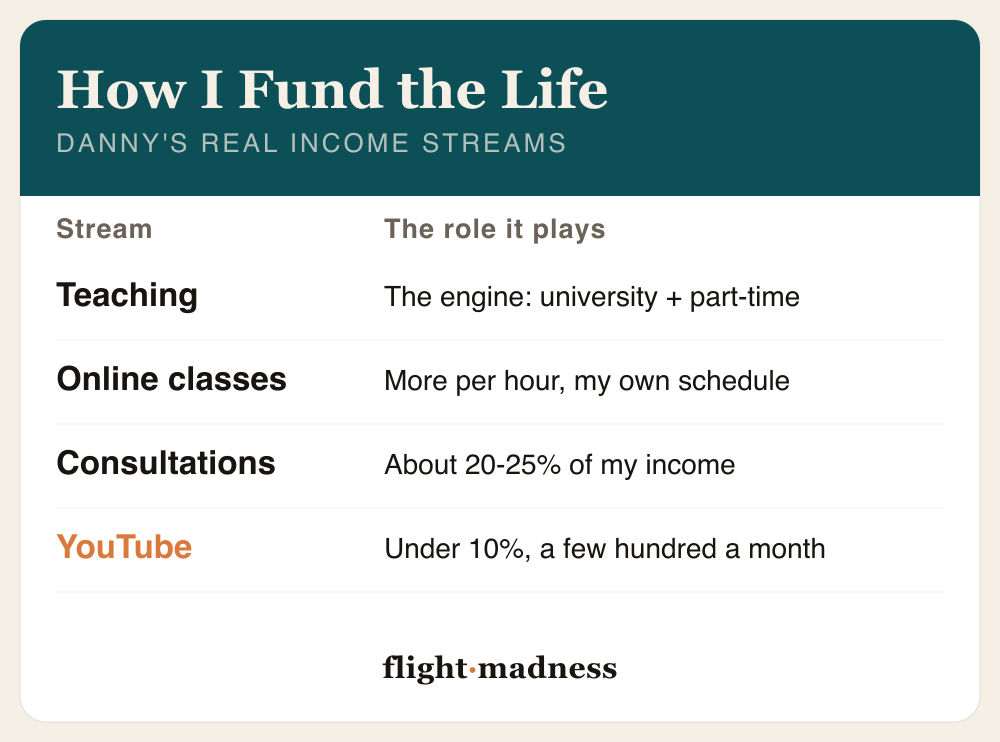
China gave me a real financial foundation, the kind a normal job back home never would have. The low cost of living is only half of it. Teaching is what fills the gap, and the gap is where the whole life gets built. If you want to see how I stitch the streams together, I broke it down in multiple income streams abroad.
Want to Run Your Numbers With Me?
If the math is starting to click, let's stop daydreaming and make it real. Book a free 15-minute Get Overseas Strategy Call and we'll run your actual numbers. I'll show you how a teaching salary covers your life out here, and how to get you over there this year instead of "someday." I've helped guys go from stuck to a teaching job in under 30 days.
Book My Free 15-Minute Strategy Call →Free. No pressure. Just a clear next step.
Frequently Asked Questions
How much does it cost to live in China per month?
It depends heavily on your city. Beijing and Shanghai cost far more than a place like Chengdu or a smaller city, where your money stretches a lot further. The more useful question is the gap: a teaching salary is strong against local costs, so a comfortable life with room to save is very doable outside the megacity centers.
Is it cheap to live in China as a teacher?
Yes, but the real point is not hitting some tiny monthly budget. It is that a teaching salary goes a long way against local prices, so you live well and still bank money every month. Your cash stretches furthest in the smaller cities, while the megacities cost more.
Is China cheaper than America?
For day-to-day life outside the top-tier cities, dramatically. Rent, food, and transport are a fraction of US prices, and the country is cashless and convenient. The bigger point is that you earn locally at a strong rate while spending at a low one, which is what lets people save fast.
How much is rent in China?
Outside the Beijing and Shanghai centers, a good apartment costs a fraction of a US city, and many teaching jobs add a housing allowance or help arrange a place. Rent is the bucket your city choice controls most, so where you live sets your whole budget.
How much money do you need to live in China?
Less than you think outside the megacities. The smart move is to earn a teaching salary that beats local prices, so you live well and still put money away every month. Your city and whether the job covers housing are the two biggest levers on the number.