What Is Geoarbitrage?
Geoarbitrage (geographic arbitrage) means earning your money in a strong currency and spending it in a place where the cost of living is low. You keep the income, you ditch the expenses. The gap between the two is your new freedom.
That's it. You don't have to get a raise. You don't have to get rich. You just stop spending dollars like an American and start spending them like a king somewhere cheaper. $25 an hour online feels like $80 an hour when your rent is $300.
It's Not the Debt. It's the Terrain.
Here's the part nobody tells you. When you're broke in America, you blame the debt. But the debt isn't really the enemy. The environment is.
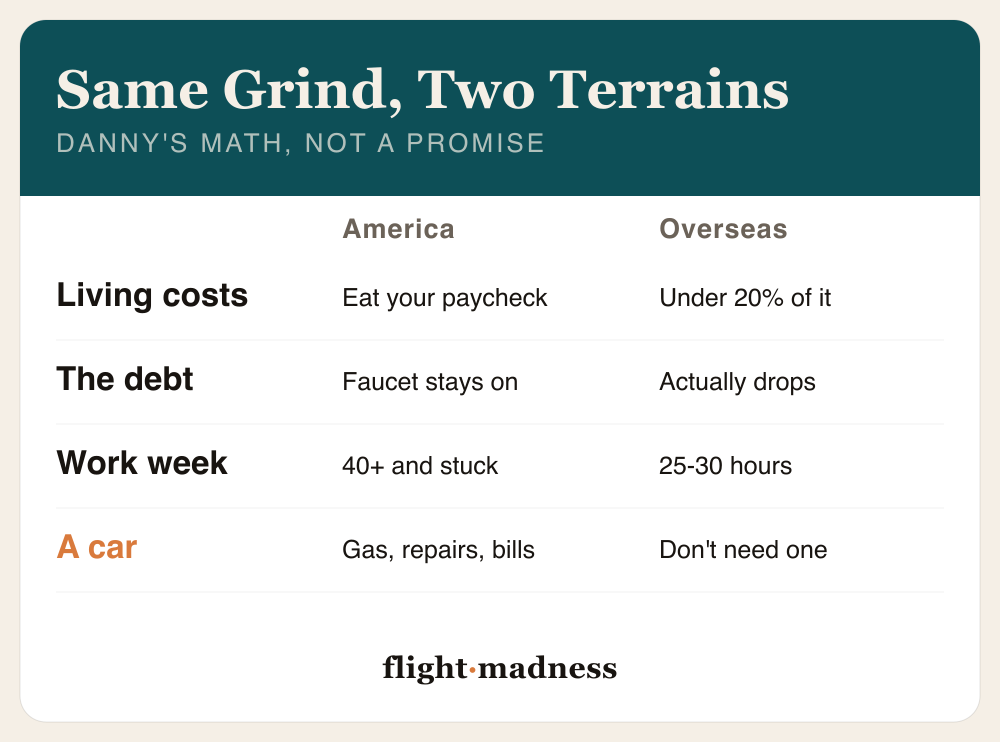
Trying to pay off debt in America is like trying to drain a bathtub with the faucet still running. You're scooping water out as fast as you can, and the level barely moves, because high rent, high food costs, gas, and a car that breaks keep pouring back in. You can grind harder all you want. You're grinding in a place designed to keep you treading water.
We call America the matrix for a reason. The system gives you just enough to keep going, never quite enough to escape. You make your payments, you survive, and the principal never really drops. That's not an accident. That's the design.

Change the Terrain (the Art of War Move)
There's an idea in Sun Tzu's Art of War: don't fight the enemy on terrain where they're stronger than you. In America, the high cost of living is that terrain, and it's stacked against you.
So you do the smart thing. You change the terrain. You move your life to a lower-cost country where you earn a solid income relative to what things cost. Now the same effort that barely kept your head above water in the States actually pays down debt AND buys you a better life at the same time. You don't magically become richer overseas. Your expenses just collapse, and suddenly there's room to breathe.
I know this works because I did it. I left the US with about $15,000 in student loan debt and almost no savings. It was scary to leave with debt still strapped to my ankles. But you know what was scarier? Staying. Because I watched guys get stuck. They buy the house, they have the kid, they take on more debt, and the door quietly closes. I took the risk and changed my terrain instead. Best move I ever made.
The Actual Math
Let me show you why the numbers work out here.
- I don't even own a car. In the States that was gas plus repairs that ran into the hundreds. Out here transport is cheap, and in a lot of cities you don't need a vehicle at all.
- Your cost of living can run under 20% of your paycheck. Read that again. Most of your income is yours to keep, save, or throw at debt.
- I rarely work more than 30 hours a week. The average English teacher out here works around 25 hours a week and still earns well against the local cost of living.
That's the whole trick. Strong income, tiny monthly expenses, more time. It's not a get-rich-quick game. It's a get-free-slowly-but-surely game. If you're wondering whether your US salary is the problem, it usually isn't: read is $100k a good salary.
How You Actually Pull It Off
Geoarbitrage only works if you've got income that follows you across the border. For most guys, the fastest way to get that is English teaching. It's the baseline. It gets you on the ground in a cheaper country with money coming in, and from there you'll spot side hustles and opportunities you can't even see from where you're sitting now. That's how you build multiple income streams abroad. To see just how far a small income stretches overseas, I mapped a full month in how to live abroad on $1,000 a month.
I've taught for 12 years, classroom then 100% online from Thailand, rarely more than 30 hours a week. And here's the part that surprises people: you can move fast. If you're actually ready, the timeline from "still in the matrix" to "living overseas" can be as short as 30 to 90 days. Pick your country with best countries for expats, or see one move in detail in moving to Thailand.
You Don't Need $100k Saved to Do This
Here's the trap I watch guys fall into. They tell me "I'm not moving until I've got $50,000 saved up" or "I need $100,000 and dividend income before I go." Sounds responsible. It's actually a way of never going, because those guys aren't buying things with money. They're buying certainty. And the goalposts always move: $50k becomes $75k, then a little more, then a little more.
My engineering brain calls the fix MVP: minimum viable product. The bare minimum for geographic arbitrage isn't a war chest, it's income that sustains you in the country you pick. That's it. The biggest problem for most guys isn't savings, it's cash flow. Waiting until every dollar is stacked is like sitting in your car waiting for every light in town to turn green before you touch the ignition.
I left with $15,000 of debt and almost nothing saved, and it still worked, because the lower cost terrain did the heavy lifting. There's a Stoic line from Seneca I think about: it's not that we have a short life, it's that we waste a lot of it. Waiting for perfect is the waste.
Get the Free Quickstart Teaching Guide
The practical roadmap for using English teaching to get overseas with income coming in. The countries, the job types, and the kind of money you can make.
Free guide. Real information, not hype. Unsubscribe anytime.
What the Other Side Actually Looks Like
So what does life look like once the geoarbitrage math is working for you instead of against you? In Southeast Asia, somewhere around $1,300 to $1,800 a month has you living like a king. At $3,000 to $5,000 a month you're at what I call boss king level, a 1% lifestyle that would take a fortune in any major American city. Same job, same skills, different terrain.
And it's not just the money. It's what the money stops costing you. Lower stress. Healthcare costs that tend to run a lot more affordable than in the States (I've had surgery in a foreign country). Time back, because 25 to 30 hours of work covers everything with room to spare. Remote workers figured this out years ago. Teachers have been quietly living it for decades.
Some guys use geoarbitrage to stack savings. Some use it to finally kill their debt. I used it for both, and then just kept the life, because it turned out the life was the point.
Want to Run Your Own Numbers?
Book a free 15-minute Get Overseas Strategy Call. We'll look at your debt, your income, and the fastest path to a cheaper country where your money actually stretches.
Book My Free 15-Minute Strategy Call →Free. No pressure. Just a clear next step.
Frequently Asked Questions
What is geoarbitrage?
Geoarbitrage, or geographic arbitrage, is earning money in a strong economy (or remotely in dollars) while living somewhere with a much lower cost of living. You keep a high income and slash your expenses, and the gap between the two becomes savings, freedom, or debt you can finally pay off.
How does geoarbitrage work in practice?
You set up income that travels with you (for most guys that is online English teaching or remote work), then move to a lower-cost country like Thailand, Vietnam, or Cambodia. Your rent, food, and transport drop dramatically while your income stays strong, so the same paycheck goes a lot further.
What is an example of geographic arbitrage?
Earning $25 an hour teaching English online while living somewhere your rent is around $300 a month. That income would feel tight in a US city, but in a low-cost country it can cover a comfortable life with money left over. I did exactly this, paying down $15,000 in student debt while living better than I did in the States.
Is geoarbitrage worth it?
For a lot of people, yes. It is not get-rich-quick, and you still have to work, but it can turn a paycheck that barely survives in America into a comfortable, lower-stress life abroad. The catch is you need portable income first, which is the piece most people skip.
How do I start with geoarbitrage?
Build income that is not tied to one location (online teaching is the fastest route for most guys), pick a lower-cost country, and make the move. The income piece is the one to start now.