You Don't Need to Be Rich to Leave
Most guys never leave America because of a number stuck in their head. They think they need $50,000 in the bank, or some remote job paying a full US salary, before it's safe to go. That fear is the whole thing keeping them home.
Real talk: you don't need any of that. I talk to guys back home paying $2,000 in rent, sometimes closer to $3,000 once you stack on all the monthly bills. Meanwhile, plenty of people out here live abroad on $1,000 a month, comfortably. And I mean comfortably, a higher quality of life than a lot of dudes grinding it out in the States.
I'm not guessing. People living overseas on a thousand or two a month are living better than guys pulling multiple six figures back home. The number you think you need is way bigger than the number you actually need.
The Real Math on $1,000 a Month
Let me break it down, because once you see the math, the fear goes away.
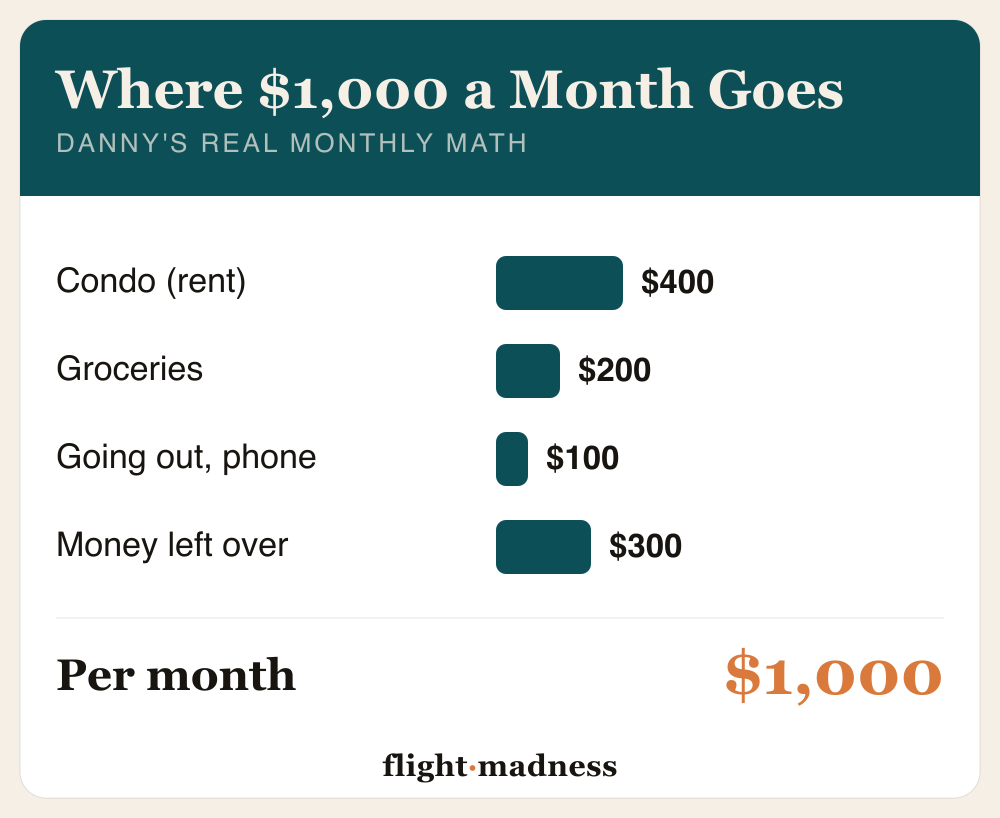
Say you've got $1,000 to $1,200 a month. Your condo runs about $400. Groceries, and I eat a lot of protein, run me around $50 a week, so call it $200. That's $600 gone, and you've still got a few hundred left. Knock off another $100 for going out and your phone bill, and you're sitting on about $300 free every single month.
A whole week of real groceries, fruit, vegetables, meat, fish, costs me under $50. I do it all the time. And that leftover $300 is yours. Blow it on a good time, or put it toward a hobby, a new skill, a side venture, whatever's going to build your life up. Back home? That same money's gone, eaten up by rent and bills before you ever touch it. Out here your dollar just hits different. That's geoarbitrage, man.
Want the Free Teaching Guide?
If teaching is your likely bridge overseas, grab my free Quickstart Teaching Guide. It lays out the field, the jobs, and the money.
Free guide. Real information, not hype. Unsubscribe anytime.
Why Your Big US Salary Lies to You
Here's what nobody tells you. That $70k, $80k, even $100k salary back home isn't what it looks like. Rent, health insurance, food, a date that runs you a couple hundred bucks and might go nowhere. A lot of things are quietly eating your money even when the number on your paycheck looks solid.
I know it firsthand. I've got an engineering background, I worked corporate America. I know the flex culture, where you make more so you spend more to impress people you don't even like, and next thing you know you're racking up credit card debt. I left the States with over $17,000 of it.
That's the hamster wheel. The salary goes up, the cost of living goes up right behind it, and your whole mental bandwidth gets eaten just surviving. Move somewhere cheap and the math flips. Paying off debt in America is like trying to drain a bathtub with the faucet still on. Out here, you finally get to turn the faucet off.
The Real Luxury Isn't Money, It's Time
Here's the part that actually changed my life, and it's not the money. It's the time.
Back home you might work 40, 50 hours a week to earn that six-figure number. Out here, you can work half that and still live great. That hands you the one thing Americans are starved for: time. Time to think, to create, to try hobbies, to build a venture or two, to become someone different than the guy who got on the plane.
There's an old book, The Richest Man in Babylon, that hammers one idea into you: pay yourself first. In America that's nearly impossible. You pay the landlord first, the creditors first, everybody else first, and there's nothing left for you. Drop your cost of living low enough and you can finally flip it.
How You Actually Get the $1,000 (Teaching English)
So you're sold on the math. The next question every guy asks me is the same: how do I actually make that money overseas?
For most American guys, the fastest answer is English teaching. I've been doing it twelve years. You can teach in a classroom, you can teach online, and honestly I'd do both, why not have more than one stream of income? Here's the kicker: a teaching salary is usually way more than the local cost of living. So you're not scraping by on $1,000, you're earning well above it and banking the difference.
The smart play is to start online while you're still in the States, get that income flowing, then line up an in-person job before you ever board the plane. I've helped a lot of guys set it up exactly like that. Inside of 30 to 90 days you can be over here living it. The only thing you really need is the courage to break out of the matrix and hop on a plane, same as me and a lot of other guys did. Here's what English teaching actually is.
Want Help Getting Overseas?
If you're ready to stop wondering and start planning, book a free 15-minute Get Overseas Strategy Call. We'll map out how teaching English can get you over here, living well on a low cost of living, often inside 30 to 90 days. I've been living this over a decade. Most guys spend that long just thinking about it.
Book My Free 15-Minute Strategy Call →Free. No pressure. Just a clear next step.
Frequently Asked Questions
How much money do you really need to live abroad?
In a lot of countries, especially in Southeast Asia, about $1,000 a month covers a comfortable life. My real math: roughly $400 for a condo, $50 a week on groceries, and you still have a few hundred left over for fun.
Can you really live abroad on $1,000 a month?
Yes, I have done it for over a decade. The fear that you need $50,000 in the bank or a full US salary is the thing keeping most guys home. Plenty of people live better overseas on $1,000 to $2,000 a month than six-figure earners do in America.
How do you make money to live abroad?
English teaching is the fastest on-ramp for Americans. You can teach in a classroom or online, and the income is usually well above the local cost of living, so you have money left over. Start online while still in the States, then line up an in-person job before you land.
Is $1,000 a month enough to live comfortably overseas?
In much of Southeast Asia, yes. It covers rent, groceries, and going out, with a few hundred left to save or put toward a hobby or side venture. The bigger win is time: you work fewer hours and still live well.