This isn't a guide I researched on the internet. This is what I'd tell you if you booked a call and asked me straight up: how do I actually move to Thailand? Money, first steps, the visa deal, where to live. All of it.
Is Thailand a Good Place to Live?
Short answer: yes. For a lot of guys, it's one of the best moves you'll ever make and the most popular destination in Southeast Asia for a reason. Long answer: it's not a brochure. The cost of living is low, the food is incredible, the beaches are real, the tropical climate is what it promises, and Thai people are some of the chillest you'll ever meet. Friends of mine fly in and out of Thailand constantly, because the flights are cheap, the overhead is low, and the people they want to see already live here.
But it's not magic. The only people I've ever had a problem with out here are other foreigners who showed up with bad energy. Respect the local customs and Thai culture, treat people well, don't be out here being a clown, and you'll be treated well right back. And there's one rule that runs the whole country: as long as you bring in the cash, you're good. If you show up broke with no income, Thailand will chew you up like anywhere else.
So Thailand being a good place to live isn't really the question. The real question is whether you show up with a way to make money. That's the whole game. Want the day-to-day picture? I broke that down in living in Thailand. Still weighing Thailand against other countries? See my ranking of the best countries for expats, or my head-to-head on China vs Thailand.
How Much Money Do You Need to Move to Thailand?
This is the question everybody asks, so let me give you actual numbers instead of vibes. For smaller Thai cities like Pattaya, you want at least $1,000 a month coming in before you move. Same floor for places like Vietnam or Cambodia. That's the bare minimum where you can live without stressing. I'll be straight with you: $1,500+ a month is a much more comfortable starting point, and that's what I usually tell guys to aim for.
Notice what I said though. Coming in. Not saved. Not "set for life." Income.
I had a guy on a livestream once say you shouldn't move overseas until you've got enough money that you never have to work again. He was 35. The way he was talking, he won't touch foreign soil until his next decade of life, if ever. That mindset is exactly how people stay trapped somewhere they aren't valued.
Here's my actual position: if I were miserable in the States, the moment I crossed that $1k a month threshold, I'd be gone. Because $25 an hour online feels like $80 an hour when your rent is $300. The dollar stretches different out here. That's not a trick, that's just math.
The Thing Nobody Tells You: You Need Income, Not a Pile of Savings
This is where most "move to Thailand" advice falls apart. People tell you to save up a war chest, then move, then figure out money later. That's backwards, and it's why so many guys burn through their savings and end up flying home.
The move that actually works is building a portable income first, then moving. And for most guys, the fastest way to do that is English teaching. I know, you didn't picture yourself as a teacher. Neither did I. I've got an engineering degree, I'm basically a tech bro who chose to teach instead. But teaching isn't the dream, it's the vehicle. It's the fastest way for us English speakers to get overseas making consistent money, and you can start it online from your bedroom in the States before you ever book a flight.
A few things people don't realize:
- You can teach online and move your schedule around. I've pushed a class back because I was on a day trip to Bangkok, then taught that night and still got paid.
- You probably don't need a degree. Most people teaching English overseas don't have one. I've helped guys with degrees and guys without.
- It's fast. My first-ever client landed a Thai teaching job after just two or three weeks of applying, and that was outside the high hiring season (Thai schools hire hardest around May and again September-October). Follow the plan and you can be overseas in 30 to 90 days.
Build the income, and the move stops being scary. It becomes a logistics problem instead of a leap of faith. If Thailand is your target specifically, read teach English in Thailand next.
Grab the Free Asia Travel Checklist
It's the stuff I actually keep handy for moving around out here. Drop your email and I'll send it over, no fluff.
Free checklist. Real information, not hype. Unsubscribe anytime.
Moving to Thailand From the USA: the Actual First Steps
People overcomplicate this so badly. They think they need a year-long master plan. You don't. There's a concept I live by from a book called The One Thing: there's usually one core action that, once you do it, makes everything else easier. Knock down the first domino and the rest fall on their own. So instead of mapping out a giant master plan, ask yourself the question I actually use: what action can I take in the next 7 to 31 days that puts my life on the path I want?
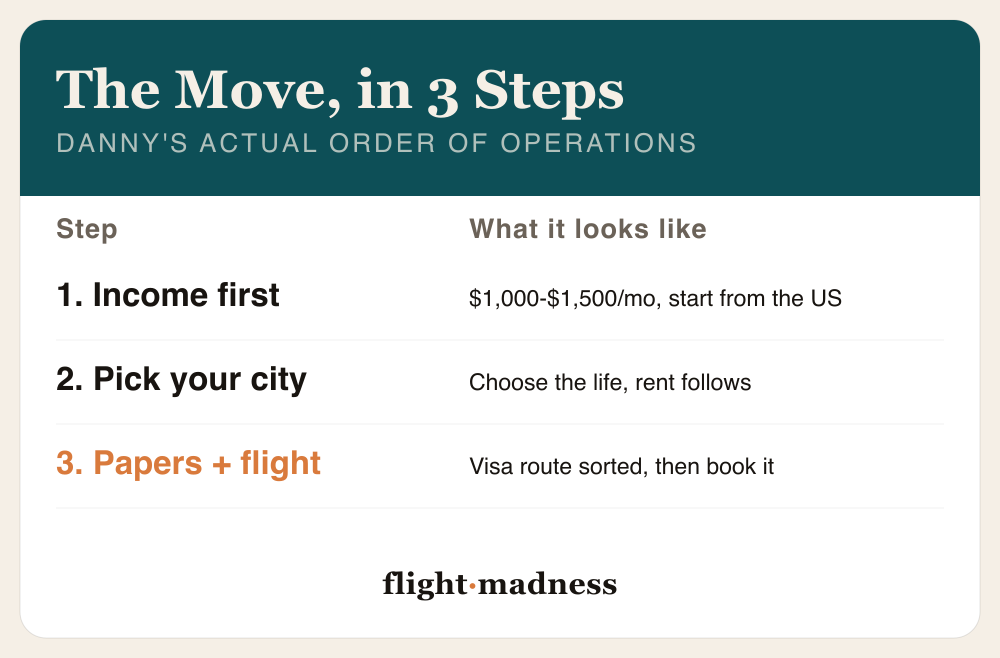
If moving to Thailand is the goal, here's the order that actually works:
- Lock in portable income. Start teaching English online from the US, or line up another remote skill. Get to that $1k to $1.5k a month before you go. This is the domino. Everything else is easy once this is handled.
- Pick your city and your number. Decide where you'd actually want to live and what monthly amount lets you live comfortably there.
- Sort your documents and book the flight. Passport, visa paperwork, the basics. Then book the ticket, because a plan without a flight date is just a daydream with paperwork.
That's it. People want it to be more complicated because complication is a good excuse to not start. If you've never moved abroad before, my full how to move to another country guide covers the mindset side.
The Thai Visa Situation (Don't Get Caught Slipping)
I'm not your immigration lawyer, and the rules shift, so always check the current requirements. But here's what changed and what I tell guys, because Thailand is cracking down and some of y'all aren't gonna make it.
The May 2025 crackdown, in plain English
As of May 2025 the Thai government tightened the visa process. You need proof of funds, real bank statements with actual money in the account. You need a digital arrival card sorted before you fly, this isn't 1998 where you scribble a paper form on the plane. And some short-term tourists are seeing their stays cut shorter.
Here's who it does NOT affect: the retirees, the remote workers, and the teachers whose schools sponsor their work visa. It's aimed at the guys who show up broke on a tourist visa, overstay, and live off border runs. Thailand is trying to move from quantity to quality foreigners, because it's competing with Malaysia, Vietnam, and Bali for the good ones. If you've got a plan and money coming in, you'll be okay. If you're moving like a broke smelly backpacker, your time might be up.
The visa categories I actually point guys at
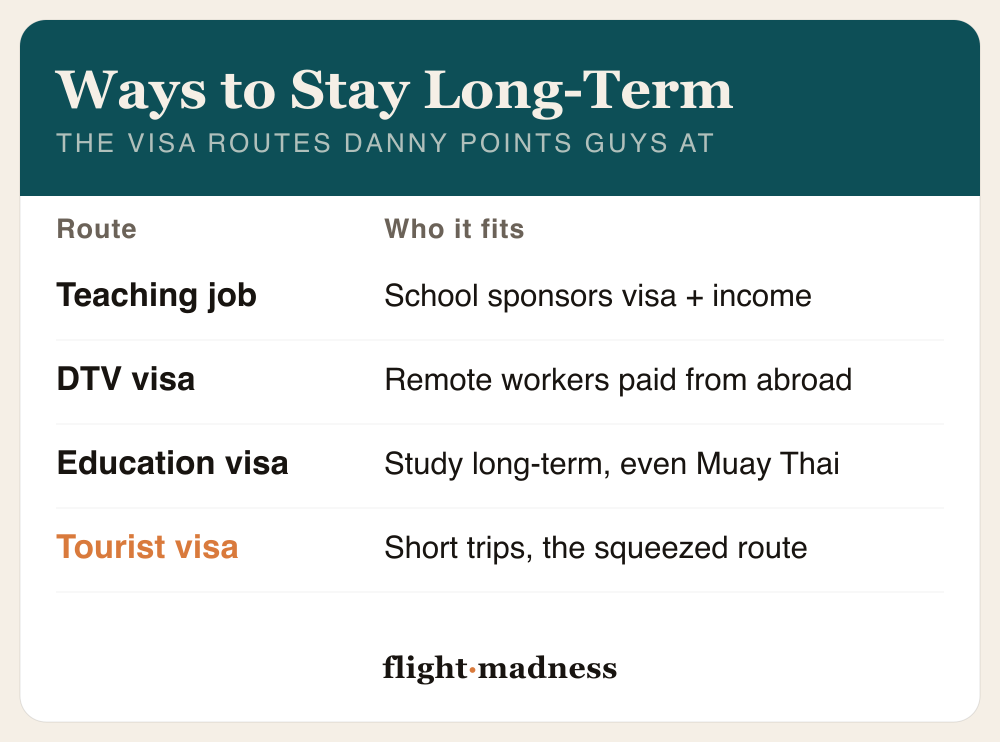
Stop relying on tourist visas. Thailand offers a variety of long-term routes, and the right one depends on how you make your money:
- A teaching job that sponsors you. If you're serious, this is the cleanest path: the school handles your work visa and work permit, and your income and your right to stay come in one package.
- The DTV (Destination Thailand Visa). The newer long-stay route built for remote workers and digital nomads earning from outside Thailand.
- An education visa. Study something real, they even have Muay Thai visas, and stay long-term while you do it.
Whichever route: get your money right before you come, and have the documents buttoned up before you fly. The wrong move here can cost you a flight home, which is exactly why this is half of what I cover on the strategy calls.
The Grown-Up Stuff: Health Insurance, Banking, Paperwork
Nobody moves to Southeast Asia for the admin, but handling three boring things separates the guys who thrive from the guys who crash out.
Health insurance. Get covered. I've had surgery in a foreign country, and healthcare costs out here tend to be a lot more affordable than in the States, but "affordable" isn't "free", and adequate health insurance is part of coming correct. Budget a line for it.
Money and banking. Plan your cash flow for the transition. A lot of overseas employers pay once a month, not every two weeks like back home, so your first weeks need a cushion. Thailand also runs on cash and Thai baht more than you'd expect, and sorting a local bank account is one of those first-month jobs that makes everything smoother.
Documents. Passport validity, the digital arrival card, whatever your visa route needs. Have it buttoned up before the airport, not at the airport.
Where to Live: the Major Expat Hubs
Quick rundown of the major cities and hubs so you're not picking blind. The expat community in every one of these is big enough that you won't be figuring things out alone.
Bangkok
Big city energy, the most jobs, the most going on, the best base if you want to plug into the expat and entrepreneur scene. The flashy city center costs more than the rest of the country, still cheap by US standards.
Chiang Mai
The digital nomad capital, up in northern Thailand. Cheaper, slower, mountains, huge remote-work community. Great if you're working online.
Pattaya
Where I live. Cheap, beachy, very walkable (you genuinely don't need a car, though I skip the motorbikes myself, a little too dangerous for my taste). It has a reputation and earns some of it, but plenty of guys build a normal life here. This is the city I quoted the $1k floor for. Fair warning: it's not a secret anymore, the streets are full of foreigners now.
Hua Hin, Koh Samui, and the quieter coast
Hua Hin is the calmer beach town, popular with people who want the coast without the chaos. If it's the island lifestyle you're after, Koh Samui is the big name, prettier and pricier than the mainland beach towns.
There's no single right answer. Pick based on whether you want city, mountains, beach, or island, then go spend a month there before you sign anything. You'll know fast.
Why Most Guys Never Go (and How Not to Be One of Them)
I'll leave you with the real talk. Most guys won't actually move. They love the idea of it. They like imagining the lifestyle. They're in the Facebook groups going "what country we going to next, bro?" And then when it's time to actually book the trip and do the thing, you can't find them anywhere.
Don't be that guy. I've had dudes in my inbox for years, literally years, telling me they're going to do it. They never do. Meanwhile the ones who just picked one action and started are out here living it. Three months from now is coming whether you plan for it or not. You can be three months closer to Thailand, or you can be in the same chair watching the same videos. Your call.
Map Your Thailand Move on a Free Call
If you want to move to Thailand but you're stuck on the income, the visa, or the order to do things in, don't spin on it for months by yourself.
Get on a free 15-minute Get Overseas Strategy Call with me. We'll talk through your income, your timeline, and the fastest path to get you on the ground. I was the guy who actually did it. I can help you map yours.
Book My Free 15-Minute Strategy Call →Free. No pressure. Just a clear next step.
Frequently Asked Questions
How much money do you need to move to Thailand?
At least $1,000 a month in income for smaller cities like Pattaya, and $1,500+ a month for a more comfortable start. The key word is income, money coming in, not a giant savings account. The dollar stretches a long way in Thailand, so you need less than you think, but you do need something consistent coming in.
Can an American move to Thailand?
Yes. Americans move to Thailand all the time. You will need the right visa for your situation and a way to support yourself, but there is no barrier stopping you from doing it. The visa rules change, so check the current requirements before you book.
Do you need a degree to teach English in Thailand?
Not necessarily. Most people teaching English overseas do not have a university degree. A degree helps and opens more doors, but I have helped guys without one get teaching work too. Teaching is the fastest way most guys build the income to make the move.
What is the best place to live in Thailand?
Depends what you want. Bangkok for city life and the most jobs, Chiang Mai for cheap and remote-work friendly, Pattaya or Hua Hin for the beach. Spend a month somewhere before you commit to it.
How do I move to Thailand from the USA?
Build a portable income first (online English teaching is the fastest route for most guys), pick your city and your monthly budget, sort your visa paperwork, and book the flight. Start the income piece now, because that is the one thing that makes the rest easy.
What visa do you need to move to Thailand?
It depends on how you fund your life. The routes I point guys at: a teaching job that sponsors a work visa, the DTV visa for remote workers, or an education visa. Stop relying on tourist visas and border runs, that game got squeezed hard in the May 2025 crackdown. Check the current rules before you book anything.
Is Thailand cracking down on expats?
On broke ones, yes. Since May 2025 there is proof of funds, a digital arrival card, and shorter stays for some tourists. It does not touch people with real income: teachers on sponsored visas, remote workers, retirees. Show up with a plan and money coming in and you are fine.