The Dream You Were Sold
Let me tell you about the lie a lot of us were sold: give your life to a company, work a thousand years at the company, and they'll repay you when you're old.
I had a cubicle job. I was around people who had given their lives to that system. One dude had been sitting at the exact same desk for 35 years. Another guy used to say, "if I just make it 12 more years, I can make it to retirement." Twelve more years, man. And the reward for a decade of loyal grinding? Maybe an extra few days of vacation, so you can finally have a two-week vacation once a year.

That's the deal on the table in America. Work your best decades in a chair, 50 or 60 hours a week, and cash out when your knees and your energy are already going. You're stuck in the anthill, a rat in the rat race, waiting on a golden parachute that lands at 65.
And here's how that career actually ends. The company throws you a retirement party at 65. Everyone claps: "he worked at this company for 40 years!" Then the second you pack up your stuff, they forget you ever existed. That's the finish line you're grinding toward.
Meanwhile the pay is calibrated to keep you in the race. You earn just enough to upgrade your prison cell, never enough to break out of prison. The American dream got re-priced while you were grinding.
Why Waiting Until 65 Fails
There's a book that put words to what I was already living: Die With Zero by Bill Perkins. The question it makes you ask is simple. What's the point of having all those millions of dollars if you don't get to enjoy them at your full vitality?
Money is most valuable when it can buy meaningful life experiences. And the same money buys different amounts of life at different ages. $10,000 at 30 can buy you a meaningful life experience, an adventure you'll carry forever. $10,000 at 65 might not do much for you.
And here's the part nobody wants to hear: it's a double decay. As you age, your ability to do things drops, the body starts to age. But your desire drops too. At 20 you'll happily sleep in a dirty hostel to see the world. At 50 or 60? Heck no, you're not staying in any dirty hostel. So you need a lot more money to enjoy yourself at that age, and you have less desire to do the things the money is for.
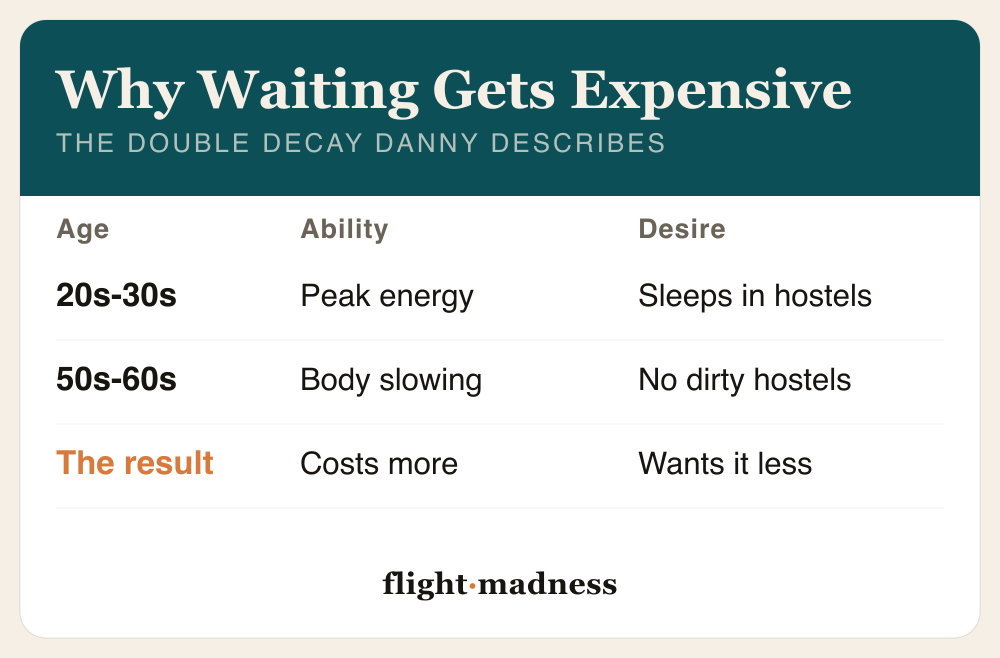
That's the trap in "wait until 65." You're saving your life up for a version of you who can't spend it.
I've Met the Guys Who Did It the Normal Way
This isn't theory for me. Pattaya is full of guys who ran the standard play: full career, pension locked in, then retirement in Thailand. I've hung out with them. They're comfortable, they made it, and honestly? A lot of that retirement life looks a little boring. You reach the point where you don't have to work, the kids are grown, and you're stuck with a new problem: okay, what do I do now?

Here's the thing those guys understand better than anyone. They spent their whole lives getting the money, and now they look back and realize their time was really the most valuable thing. So here's my advice: you definitely don't want to waste yours working terrible jobs, saving for a time in the future when you might finally get to travel.
That's why my plan isn't "stop working someday." I plan on always working on something, always making progress on some project. A mini retirement isn't the absence of work. It's work small enough, and life cheap enough, that your time belongs to you the whole way through.
Your Peak Earning Years Are Your Peak Living Years
A lot of guys look at their 20s and 30s as their peak earning years. Grind now, live later. But they're not just your peak earning years. They're also your peak living years.
Now, I'm not advising you to live like a brokie. This isn't the $500-a-month ramen noodle backpacker plan. And it's not the other extreme either, the guy doing 80 hours a week in the office and giving up his whole life for money. It's not A or B. You can mix both, and you can go in cycles: work harder some seasons, work less in others.
That's what a mini retirement really is in my world. Not a one-time sabbatical you take between jobs. A way of structuring your life so the living happens now, in your strongest years, funded by work that doesn't eat you alive.
Mini Retirement vs Career Break: Two Different Plans
Quick definitions, because the internet uses these words loosely. The standard version of a mini retirement is basically a planned career break. You take a break from the job for a few months, maybe a year. You spend time on travel or family or whatever the career was crowding out. Then you step back onto the career path. A one-time event, "practicing retirement" before the real one. If that's all you want, fine, it beats never stopping.
My version flips the whole frame. I didn't take a break from my life to travel. I rebuilt the life so it doesn't need breaks. When your monthly costs collapse and a couple hours of work covers everything, the mini retirement stops being a pause between jobs and becomes the default setting.
One is a vacation from the machine. The other is leaving the machine. Same words, completely different plan.

The Math That Makes It Work
Here's the engine under all of this, and it's simple: in America you might need $5,000 to $7,000 a month just to maintain your life. Overseas, in Southeast Asia or South America, you can live on about $1,300 to $1,800 a month, and you're living like a king.
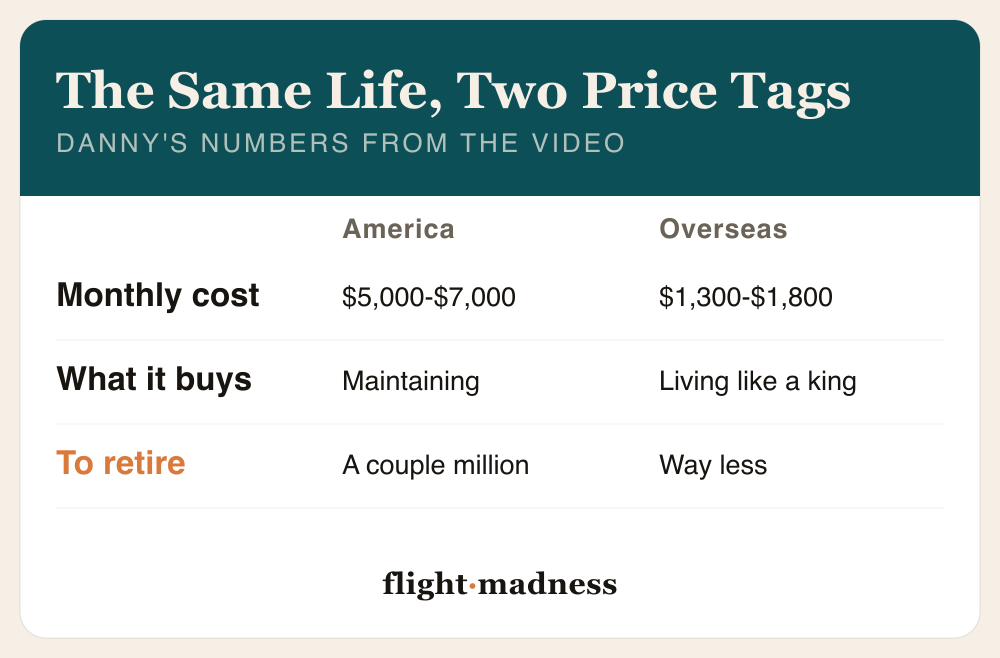
And it scales up beautifully: around four grand a month in a lot of countries buys you the same quality of life as someone making a hundred K or more in the States. That gap is geographic arbitrage, and if you come from a rich Western country like America, it's sitting right there waiting for you.
You keep your dollar earning power and you point it at a place where the cost of living is a fraction of home. In America you might need a couple million dollars to retire. Overseas, you can retire on way less. You don't need to be a millionaire to do this.

People living overseas on $2,000 a month are living a higher quality of life than people making multiple six figures in America. I've watched it with my own eyes for over a decade. I broke the full mechanism down in geoarbitrage and mapped a whole month's budget in how to live abroad on $1,000 a month.
Get the Free Quickstart Teaching Guide
The practical roadmap for using English teaching to get overseas with income coming in. The countries, the job types, and the kind of money you can make.
Free guide. Real information, not hype. Unsubscribe anytime.
The Engine: Income That Doesn't Eat Your Life
A mini retirement needs fuel, and the fuel is portable income that doesn't take 40 hours a week to earn.
For me, and for most guys I help, that's English teaching. It's the fastest way for us Americans to get overseas making money. It's stable, and there are tons of jobs, because English is the language of the world and everybody wants to learn it. With English teaching you don't need to work that much, and the money is really good relative to your cost of living out here.
And teaching is the floor, not the ceiling. I've got side hustles stacked on top: my own travel products, the content I make. Once you're on the ground, you'll see opportunities you can't even see from your couch in America. Teaching funds the stable base so you can build whatever you want on top of it. That's how you end up with multiple income streams abroad.
What My "Retired" Actually Looks Like
I live in Pattaya, Thailand. I wake up when I want, walk on the beach, hit the gym, eat fresh meals. Then I open the laptop, teach for a while, and the money gets deposited. I film content I enjoy. Very rarely do I ever work more than 25 to 30 hours a week, and most weeks it's a lot less. Going online actually tripled my income while cutting my hours.
The free time is the real luxury. As an English teacher you get whole afternoons to work on your own ventures, and with the free time and income I have, I could take an international trip every month if I wanted to. Sometimes I do.

While an American worker might work all year for a two-week vacation, out here basically every day is a vacation. Some time back, my friends and I decided on a whim to go to Bali. We all bought plane tickets and went that week. That's not a bucket-list moment out here. That's just a week.
That's not luck. That's design. And the blueprint isn't a secret, it's the same one I walk guys through every week.
How You Actually Start
You don't need a decade of planning. If you're actually ready and you follow the plan, you can be overseas in 30 to 90 days, maybe even faster.
The first domino is the income: get to $1,000 to $1,500 a month portable, and online teaching is something you can start from the States before you ever book a flight. Then pick your country and city (best countries for expats is my ranking, moving to Thailand is the full playbook for mine). Then sort the paperwork and book the ticket.
Two honest warnings from someone living it. First, freedom has a dark side: hand yourself a mountain of free time with no structure and you can crash out just as hard as you burned out. Build your days around something. Second, plan for the boring stuff, health insurance included, because being covered is part of doing this like an adult.
One of my favorite Stoic lines is from Seneca: it's not that we have a short life, it's that we waste a lot of it. Your 30s are happening right now. You can spend them at the desk next to the guy counting down his last 12 years, or you can go find out what a Tuesday feels like when it belongs to you.
Want to Map Your Version of This?
Book a free 15-minute Get Overseas Strategy Call. We'll map your mini retirement: the income, the country, and the timeline to get you there.
Book My Free 15-Minute Strategy Call →Free. No pressure. Just a clear next step.
Frequently Asked Questions
What is a mini retirement?
Most people use the term for a deliberate break from work taken long before retirement age. My version goes further: build a low-cost, high-freedom life overseas where a couple hours of work a day covers everything, so the "retirement" part never has to end.
How much money do you need for a mini retirement?
Less than you think, if you do it overseas. In Southeast Asia you can live really well on $1,300 to $1,800 a month, and I tell guys to have at least $1,000 a month in portable income lined up before they move, $1,500 or more to be comfortable. The key is income coming in, not a giant pile of savings.
Is retiring in your 30s irresponsible?
Living like a brokie with no income is irresponsible. That is not this. You are working, just less, in a place where your dollars stretch several times further, and you can work in cycles: harder some seasons, lighter in others. What I would call irresponsible is spending your strongest decades at a desk and hoping the 65-year-old version of you still wants the life you postponed.
How long should a mini retirement last?
The standard career-break version runs a few months to a year, then you go back. I think that is aiming too low. Build the overseas version, where low costs and a light work week fund the lifestyle permanently, and the question stops mattering. Mine has lasted over a decade so far.
What about health insurance during a mini retirement?
Plan for it, same as rent. The good news is that healthcare costs in the countries where a mini retirement makes sense tend to be a lot more affordable than in the States, so it is a budget line, not a reason to stay home.
What is the difference between semi retirement and a mini retirement?
Semi retirement usually means permanently working part-time. A mini retirement is usually framed as a temporary break. The overseas version I live blends the two: part-time work, full-time freedom, no end date needed.